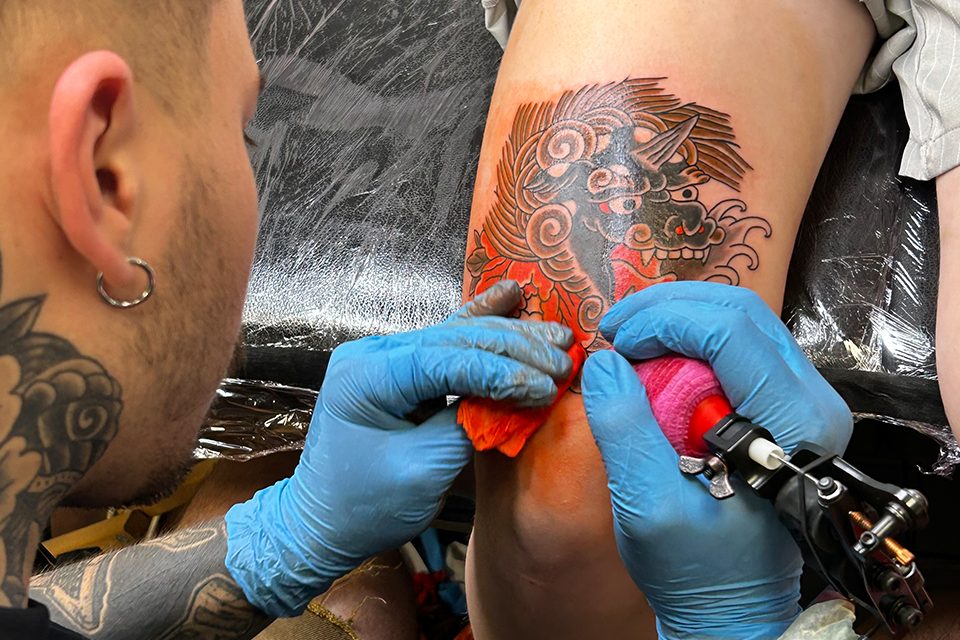
Traditional, also known as old school tattoos, are easily recognized by bold black outlines, basic color pallete and iconic designs. This style has its roots in 20th century, most popular between soldiers and rebellious communities.
Characteristics of a old school tattoo
1. Bold black linework Tattoos in this style have bold black outlines which give the tattoo a clear definition and guarantee their readability. The lines are simple, yet very bold.
Basic color pallette Mostly basic colors are used in traditional, including: black, red, green, yellow and brown. Colors are packed in solid with minimal shading which gives the tattoo a clean, bold and readable vibe.
3. Ikonické motívy: Old school tetovanie obsahuje tradičné motívy ako kotvy, orly, ruže, dýky, srdcia s menami, morské panny a lastovičky. Avšak versatilita tohoto štýlu mi umožňuje nakresliť čokoľvek čo má zákazník na mysli.
4. Symbolika a význam: Každý dizajn v tomto štýle má hlboký význam. Napríklad, kotva symbolizuje stabilitu a silu, orol predstavuje slobodu a patriotizmus, lastovička je znakom návratu domov a bezpečnosti, v minulosti si tiež lastovičky dávali tetovať námorníci ktorí precestovali na mori 5000 míl.
History and origin
Traditional tattooing began to take shape in the 19th and early 20th centuries, when sailors began using tattoos as symbols of their identity and experience at sea. The style was later popularized in America by legendary tattoo artists such as Norman "Sailor Jerry" Collins, who introduced new techniques, invented new tattoo pigments, invented new types of needles, and even invented power supplies. Other pioneers of the style included August Cap Coleman, Bert Grimm, Paul Rogers, Stoney St. Clair, and later, around the 1980s, Lyle Tuttle and the very famous Don Ed Hardy.
Flash Painting
In the past, tattoo studios did not operate on the principle we know them today, where the customer comes with their own idea, the tattoo artist prepares a custom design for them, and they go to get a tattoo.
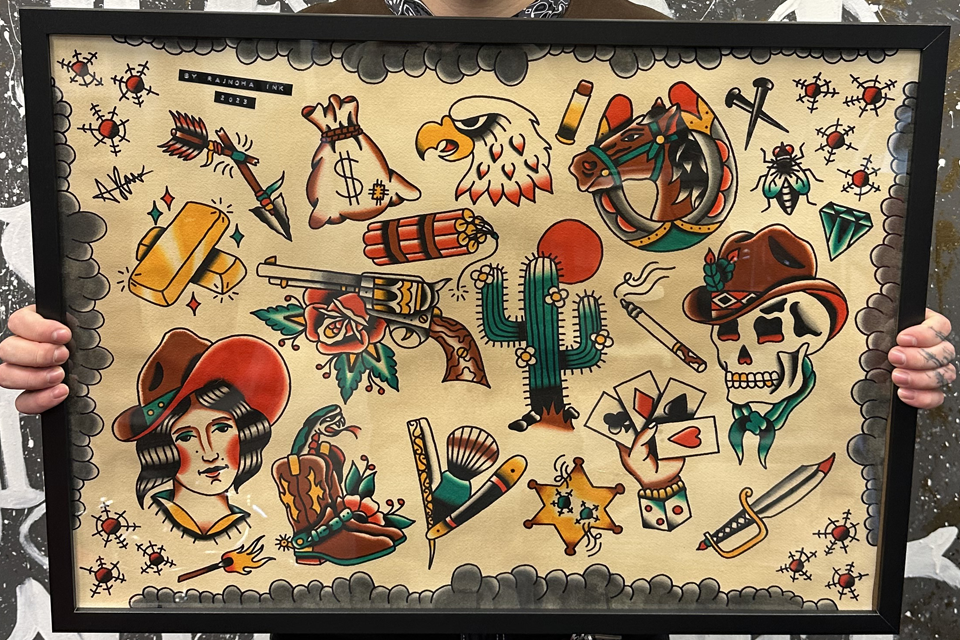
When a person came to a tattoo shop, they immediately noticed that the entire space was decorated with tattoo flash.
Tattoo flash is a collection of designs painted with ink and watercolors using the spitshading technique.
Spitshading is a technique where the artist uses two brushes, one for the paint and the other in his mouth and moistens it with saliva. With the paint brush, he applies pigment to a selected part of the flash and then with the second brush he runs along the edge of the applied paint in side-to-side movements, creating a smooth transition between the paint and the clean paper, hence the name spitshading. This technique is mainly used to shade the flash or the author can also use it to connect colors with a smooth transition. Nowadays, it is not necessary to use saliva because there are, for example, brushes that can be filled with water, but the disadvantage of these brushes is that the painter does not have as much control over the paint with them as when spitshading in the traditional way.
These flash were hung on the walls of almost the entire space of the tattoo studio and served as a kind of catalog of designs for the customer to choose from. Among the motifs were often the most iconic designs such as eagles, skulls, snakes, roses and the like. This tradition continues to this day and most tattoo artists who are dedicated to this style still paint flash for their customers, including me. The first person who deviated from this tradition and introduced a new tattoo trend was Don Ed Hardy when he opened the first tattoo studio in 1974 where he prepared custom designs for customers. This standard has been preserved to this day and most ordinary tattoo studios operate on this principle.
Personally, I greatly value the tradition of painting flashes, but also the innovations of Ed Hardy, which is why I offer both options to customers, so you can either choose from my flashes or I will be happy to prepare a custom design exactly according to your idea.